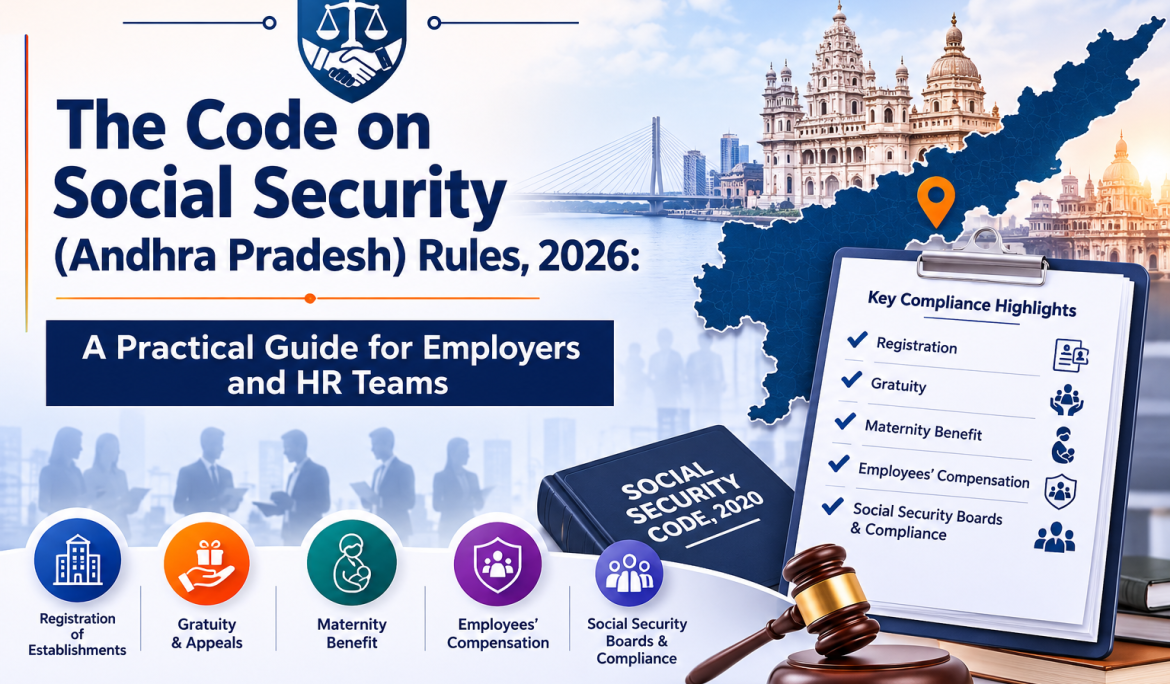
A Practical Guide for Employers and HR Teams
Published by the Government of Andhra Pradesh on 7th July 2026 (G.O.Rt.No.126, Labour, Factories, Boilers & Insurance Medical Services Department) — an insight by Chheda Consultancy Services
On 7th July 2026, the Andhra Pradesh Government notified the Code on Social Security (Andhra Pradesh) Rules, 2026, finalising the state-level framework for implementing the Code on Social Security, 2020 (Central Act No. 36 of 2020). These Rules replace four earlier enactments — the Employees’ Compensation Act, 1923, the Maternity Benefit Act, 1961, the Payment of Gratuity Act, 1972, and the Unorganised Workers’ Social Security Act, 2008 — and bring registration, gratuity, maternity benefit, employees’ compensation, cess collection, and employment reporting under one consolidated rulebook.
For employers, HR heads, and compliance teams operating in Andhra Pradesh, this is a significant shift. Below, Chheda Consultancy Services breaks down the key provisions you need to know, and what they mean for your day-to-day compliance.
1. Registration of Establishments
Every unregistered establishment must now apply electronically through Form-I of the Occupational Safety, Health and Working Conditions (Andhra Pradesh) Rules, 2026, which doubles as the common registration form under these Rules as well. Key points:
- Certificates of registration are to be issued within 7 days of a complete application — failing which registration is deemed granted automatically and a certificate is auto-generated.
- Registration lapses after 24 months if no compliance activity is reported against that registration number, though this can be revoked on application.
- Registration obtained on false information can be cancelled after a 30-day show-cause opportunity.
- A copy of the registration certificate must be displayed at the workplace at all times.
- Cancellation of registration (on closure of business) is subject to all dues being cleared and returns being filed, and must be decided within 90 days.
2. Gratuity — Nominations, Claims and Appeals
Chapter IV of the Rules lays out a detailed, form-driven process for gratuity administration:
- Nomination (Form-I): Employees must file nominations within 90 days of completing one year of service (or of the Rules commencing, for existing staff).
- Application for gratuity (Form-II): To be filed ordinarily within 30 days of gratuity becoming payable by the employee, or by a nominee/legal heir within 30 days/1 year respectively.
- Employer response: Within 15 days of receiving a claim, the employer must issue Form-III either confirming the payable amount or recording reasons for rejection.
- Fixed-term employees become eligible for gratuity after completing just one year of contract service, with periods over 6 months rounded up to a full year.
- Disputes go to the Competent Authority (Form-IV), with a further appeal mechanism (Forms V–VII) and recovery proceedings under Section 129 if an employer defaults on a payment order.
Notably excluded from ‘wages’ for gratuity computation: annual performance/productivity-linked pay, reimbursement of medical expenses, stock options, crèche allowance, telephone/internet reimbursement, and meal voucher value.
3. Maternity Benefit
- Certificates of pregnancy, delivery, miscarriage, or related illness must be furnished in Form-VIII, obtainable from a registered medical practitioner, an ASHA worker, or a qualified ANM.
- Employees give notice of their claim on Form-IX; nomination for benefit payment in case of death can be made in the same notice.
- Medical bonus: ₹3,500 where pre-natal/post-natal care isn’t provided free of charge, paid with the second instalment of maternity benefit.
- Nursing breaks: two breaks of 15 minutes each, plus an extra travel allowance (5–15 minutes) for reaching the crèche, until the child turns 15 months.
- Crèche facility is mandatory in establishments with 50 or more employees, within 1 km of the workplace (relaxable in notified industrial parks), and must meet detailed space, safety, staffing and hygiene standards.
- Where a crèche isn’t provided under a negotiated agreement, a crèche allowance of at least ₹500 per child per month (for up to two children) becomes payable instead.
- Complaints regarding withheld maternity benefit go first to the Inspector-cum-Facilitator (Form-X), with appeal to the Competent Authority (Form-XI).
4. Employees’ Compensation
- Delayed compensation attracts simple interest at 12% per annum (or as revised by the Central Government) from the date it becomes due.
- Employers must inform employees, at the time of hiring, of their right to compensation — in writing, electronically, in English, Hindi, or the local language.
- The amount to be deposited towards an employee’s funeral expenses is fixed at ₹20,000, revisable by notification.
- Claim applications (Form-XVI) may be filed electronically or by registered post with the Competent Authority for the area where the accident occurred, the employee/dependents reside, or the employer’s registered office is located.
5. Social Security Boards, ESIC Society & Compliance Machinery
- The AP Unorganised Workers Social Security Board and the AP Building & Other Construction Workers Welfare Board govern schemes for unorganised and construction workers, including group insurance, education, and medical expense support.
- An Employees’ State Insurance Society may be constituted as a managerial/healthcare body, with its own Governing Body, Executive Committee, and audited accounts (via CAG).
- Registers, wage slips, and unified annual returns (Form-XIII) must be filed online by 1st February each year, and preserved for 5 years.
- Vacancies in establishments must be reported to Career Centres (Regional/Central) as applicable, generally 15–40 days before the application deadline, under Chapter IX.
- Compounding of offences under Section 138 is now a defined electronic process (Form-XIV), with a 15-day window to pay the composition amount before prosecution is initiated.
Why This Matters for Employers
The 2026 Rules move Andhra Pradesh firmly toward a digital-first, form-driven and timeline-bound compliance regime — auto-approval of registrations, statutory response windows for gratuity and maternity claims, and mandatory electronic annual returns. Establishments that don’t already have compliance calendars mapped to these specific deadlines (7 days for registration, 15 days for gratuity notices, 24-month registration renewal, 1 February for annual returns) risk falling foul of default provisions or facing Inspector-cum-Facilitator action.
This article is a general summary prepared for informational purposes and does not constitute legal advice. Employers should refer to the full text of the Code on Social Security (Andhra Pradesh) Rules, 2026 (G.O.Rt.No.126, dated 7th July 2026) and consult a qualified professional for establishment-specific compliance guidance.
About Chheda Consultancy Services: Chheda Consultancy Services helps organisations navigate labour law, payroll and statutory compliance requirements across India, including registration, gratuity, provident fund, ESI, and social security code transitions.