
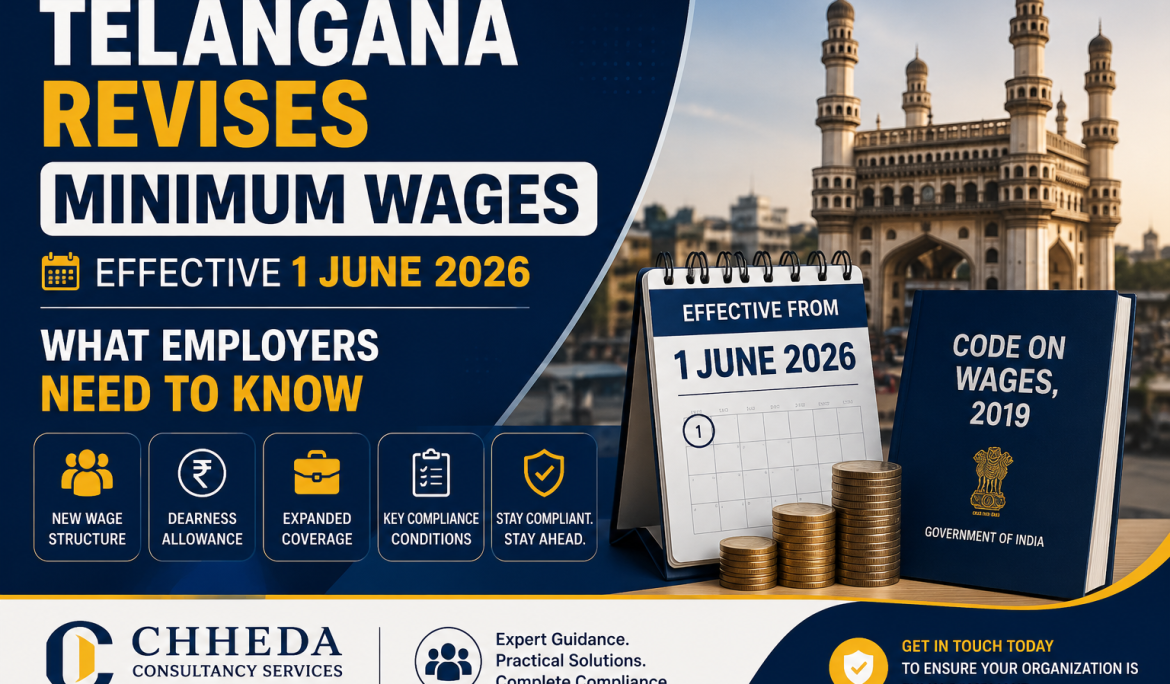
The Telangana government has issued a major revision of minimum wages under the Code on Wages, 2019, through G.O.Ms.No.6, dated 30 May 2026. The new wage structure took effect from 1 June 2026 and replaces all earlier notifications issued under the Minimum Wages Act, 1948. For businesses operating in Telangana — from factories and shops to hospitals, IT-enabled services, and e-commerce operations — this notification brings several changes that demand immediate attention from HR and payroll teams.
At Chheda Consultancy Services, we help businesses stay ahead of exactly these kinds of regulatory changes. Here’s a breakdown of what’s new and what it means for your organization.
The New Wage Structure
Minimum wages are now fixed by skill category and geographic zone:
| Skill Category | Zone I (Municipal Corporations) | Zone II (Municipalities) | Zone III (Rural & Other Areas) |
|---|---|---|---|
| Unskilled | ₹16,000 | ₹15,000 | ₹14,000 |
| Semi-Skilled | ₹17,000 | ₹16,000 | ₹15,000 |
| Skilled | ₹18,500 | ₹17,500 | ₹16,500 |
| Highly Skilled | ₹20,000 | ₹19,000 | ₹18,000 |
These are basic minimum monthly wage rates. Skill categorization is defined broadly in the order and elaborated in detail across three schedules covering hundreds of specific job roles — from watchmen and helpers (unskilled) to software engineers and project managers (highly skilled).
Cost of Living Allowance (Dearness Allowance)
The base wages are pegged to a Consumer Price Index of 443 points (2001 base year). The Commissioner of Labour will notify a variable dearness allowance twice a year — on 1 April and 1 October — based on the average CPI movement, at a rate of ₹33.86 per point for every point the index rises above 443.
New Sectors Brought Under Coverage
A notable feature of this notification is the expansion of covered employments. Ten new categories have been explicitly added to Schedule-I, including:
- E-commerce and courier services
- Religious and social institutions (temples, churches, mosques)
- Amusement parks and commercial recreation parks
- Mobile tower maintenance and TV cable/data networks
- Handicrafts, cane and bamboo industries
- Borewell drilling and maintenance
- Ready-mix concrete (RMC) units
- Aluminium and tin product units
- LPG storage and distribution agencies
Combined with the pre-existing Schedule-II list — which spans over 65 employment categories from transport and construction to domestic work, agriculture, and hospitality — the coverage under this notification is extremely broad. Most Telangana-based establishments will fall under one category or another.
Special Treatment for Piece-Rate and Labour-Intensive Industries
Certain highly labour-intensive sectors — power looms, garment manufacturing, spinning mills, brick kilns, beedi-making, and handloom weaving — will have their wages fixed separately through a dedicated Committee Method rather than the standard zone/skill matrix.
Key Compliance Conditions Employers Must Note
The notification lays out several operational requirements that go beyond just the wage figures:
- Daily wage calculation: Monthly wages are divided by 26 days (inclusive of rest-day pay) to arrive at the per-day rate.
- Trainee wages: Trainees must be paid at least 75% of the applicable category wage, but never below the unskilled minimum.
- Gender neutrality: Equal pay is mandated for male, female, transgender, and differently-abled employees performing identical or equivalent work.
- Protection of existing higher wages: Where current wages already exceed the new rates, employers must add a further 10% increase to preserve the existing advantage.
- Holiday and rest-day pay: Work on weekly offs or public holidays must be compensated at double the normal rate.
- Rounding rule: Final wage calculations must be rounded to the nearest 50 paise.
- Digital wage payment: Wages must be paid via bank transfer — NEFT, RTGS, IMPS, or bank cheque — not cash.
- Overtime: Any work beyond 8 hours a day must be paid at double the standard rate.
- Principal employer liability: Where workers are engaged through a contractor, the principal employer remains responsible for ensuring minimum wage compliance.
What This Means for Your Business
This isn’t a minor tweak — it’s a comprehensive overhaul that affects wage structuring, payroll systems, contractor management, and statutory compliance documentation. Key action items for employers include:
- Re-benchmarking current wage structures against the new zone-wise, skill-wise rates
- Auditing whether your establishment now falls under one of the newly added employment categories
- Updating payroll systems to reflect the revised overtime, holiday-pay, and rounding rules
- Reviewing contractor agreements to ensure downstream wage compliance
- Building in the twice-yearly DA revision cycle into your compensation planning
Need Help Navigating This Transition?
Wage law changes like this one carry real compliance risk if implementation is delayed or misapplied. Chheda Consultancy Services can help you audit your current wage structures, map your workforce to the correct skill categories and zones, and ensure your payroll and contractor arrangements are fully aligned with the new notification.
Get in touch with our team today to ensure your organization is fully compliant with the revised Telangana minimum wage rules.
This article is based on G.O.Ms.No.6 issued by the Labour, Employment, Training & Factories Department, Government of Telangana, dated 30 May 2026. It is intended for general informational purposes and does not constitute legal advice. Employers should consult the full official notification and a qualified professional for compliance decisions specific to their establishment.