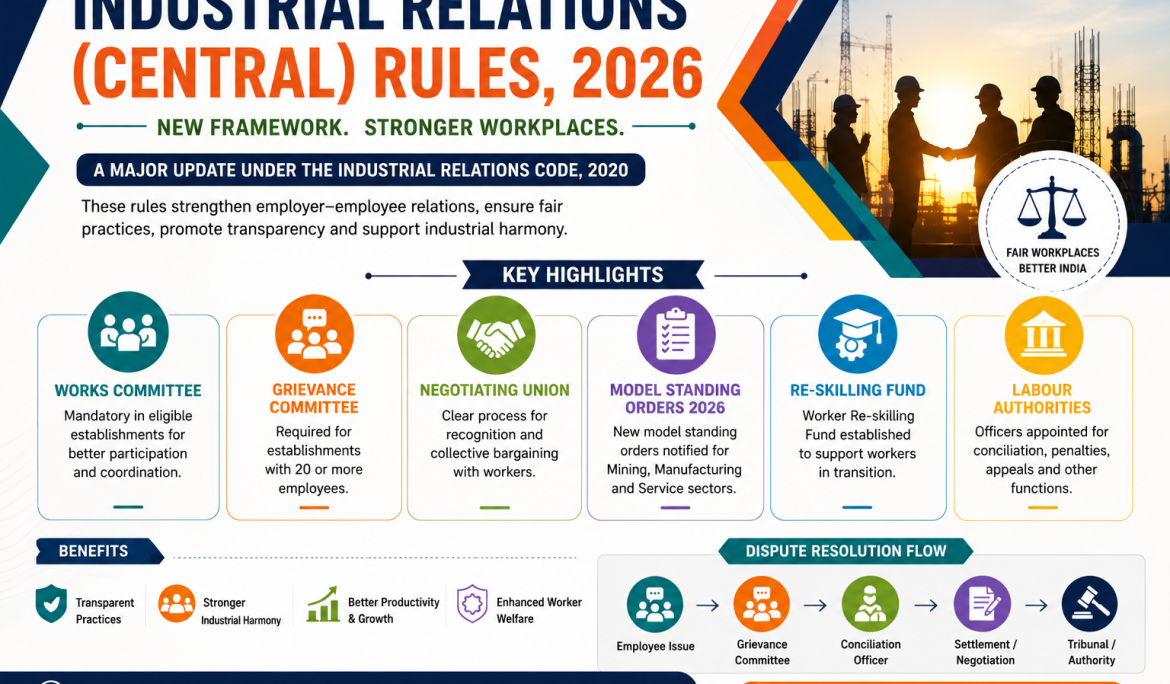
The Ministry of Labour & Employment has notified the Industrial Relations (Central) Rules, 2026, covering important provisions related to works committees, grievance redressal committees, trade unions, standing orders, and dispute resolution mechanisms. These rules aim to strengthen transparency, worker representation, and industrial harmony across establishments.
| Topic | Short Update |
|---|---|
| Works Committee | Employer & employee coordination committee required |
| Grievance Committee | Mandatory for establishments with 20+ employees |
| Negotiating Union | Rules defined for union recognition |
| Model Standing Orders | New HR and service condition rules notified |
| Fixed Term Employment | Equal wages & benefits for fixed term employees |
| Re-skilling Fund | Government introduced Worker Re-skilling Fund |
| Labour Authorities | Officers appointed for conciliation, penalties & appeals |
Simple Understanding
Employee Issue
      ↓
Grievance Committee
      ↓
Conciliation Officer
      ↓
Settlement / Tribunal
Employer Action Points
- Review standing orders
- Form grievance committee
- Update HR policies
- Maintain employee records
- Ensure labour law compliance
Appointing Conciliation Officers and specifying area of jurisdiction under section 43 (1) and (2) of IR Code 2020Download
Appointing Officers to impose penalty under section 85(1) of the Industrial Relations Code 2020Download
Delegation of power of Central Government under section 87(1) under Chapter XIII for filing complaints in the Courts forDownload
Delegation of power of Central Government to RLCs under section 59(1) for issue of Recovery Certificate under the IndustrDownload